
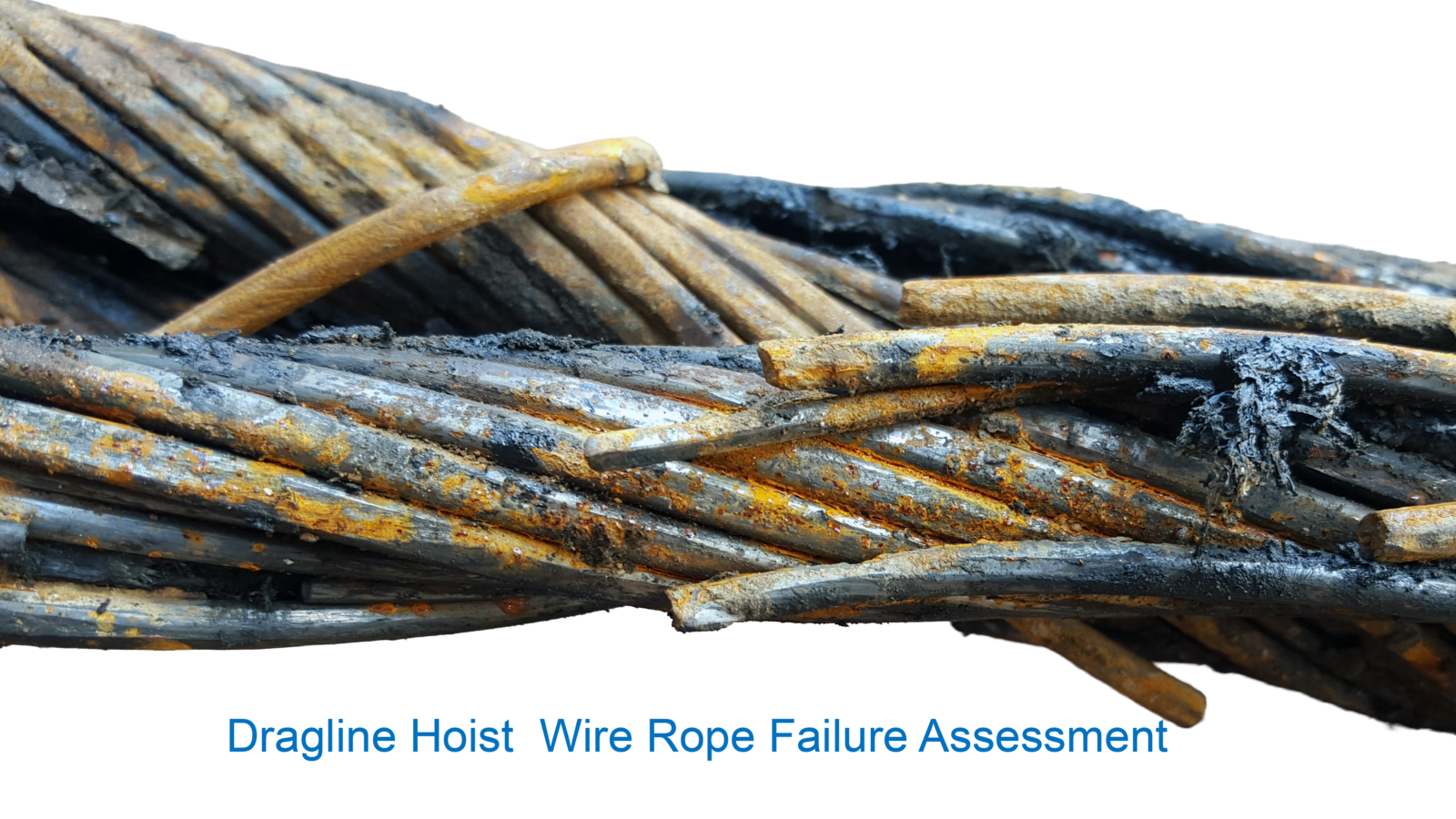

When a wire rope fails, the final break is often only the last step in the story
Problem addressed
The investigation addressed the premature failure of a dragline hoist wire rope used in heavy-duty mining service. The objective was to determine whether the failure resulted from inadequate rope material/construction, excessive loading, fatigue, wear, maintenance condition, corrosion, or a combination of these mechanisms.
The principal engineering concern was the progressive deterioration of individual wires, ultimately reducing the rope’s load-carrying capacity sufficiently for final overload failure to occur.
A finite element analysis of the wires was not part of this investigation.
Methodology used
A multidisciplinary root-cause failure investigation was undertaken, combining:
- Visual examination and reconstruction of the failed rope.
- Assessment and counting of fractured wires over a representative rope lay length.
- Fractography to distinguish fatigue from overload fracture mechanisms.
- Chemical composition and metallurgical examination.
- Tensile and mechanical-property testing of individual wires.
- Microstructural examination.
- Engineering calculation of rope loads and remaining breaking strength.
- Stress-life (S-N) fatigue analysis comparing damaged and undamaged rope conditions.
- Consideration of operating loads, lubrication, internal wire interaction and sheave-related wear mechanisms.
Key findings
The investigation concluded that the rope material itself was not the fundamental cause of failure. The wire chemistry, strength characteristics and microstructure were generally satisfactory.
The dominant deterioration mechanism was severe surface wear of both internal and external wires. Wear created local stress concentrations that promoted fatigue-crack initiation. Progressive wire fractures then reduced the effective metallic cross-section and load-carrying capability of the rope until the remaining rope ultimately failed through overload.
Fractographic examination confirmed a combination of fatigue-driven wire failures followed by ductile overload.
Importantly, the investigation found little notable residual lubricant on the examined strands. Internal wear was associated with relative movement between wires, while external wear was associated with rope/sheave interaction. The report therefore identified lubrication condition and sheave condition/alignment as important factors requiring management.
The analysis demonstrated that accumulated wire damage caused a major reduction in rope strength, approaching 50 % in the investigated condition, illustrating that apparently localised wire deterioration can materially compromise the capacity of the complete rope system.
Economic benefits
This project does not quantify a monetary saving, so a specific ROI or cost reduction was not performed.
However, implementation of the investigation’s findings provides a clear engineering basis for:
- reducing premature rope failures through improved wear control;
- avoiding unnecessary rope replacement caused by poorly controlled lubrication or sheave condition;
- improving utilisation of expensive rope assets through condition-focused maintenance;
- reducing unplanned dragline stoppages associated with rope failures, and,
- directing maintenance expenditure towards the identified degradation mechanisms rather than treating rope failure simply as a material-strength problem.
These are potential business benefits inferred from implementing the engineering recommendations, rather than financial savings.
Safety benefits
The principal safety benefit is the earlier identification and control of progressive wire-rope degradation before substantial loss of load-carrying capacity occurs.
The investigation demonstrates that wear can initiate fatigue cracking, followed by progressive wire breakage and a substantial reduction in residual rope strength before final overload failure.
Regular inspection of the rope, lubrication condition and sheaves therefore provides an opportunity to identify deterioration before it develops into a major hoisting-system failure.
Key recommendation
Adopt a proactive condition-based rope-management programme focused on wear prevention and early detection.
In particular:
- Inspect hoist ropes regularly, with particular attention to wear, corrosion and broken-wire development.
- Maintain appropriate intra-strand lubrication to limit friction, corrosion and internal wire wear.
- Inspect sheaves routinely for condition, wear and correct installation/alignment because rope/sheave interaction can contribute to external wire wear.
- Assess the rope’s service conditions and maintenance history when abnormal deterioration is identified.
- Treat increasing wire breakage and wear as indicators of progressive loss of structural capacity, rather than considering only the nominal breaking strength of the original rope.
Executive takeaway
The failure was fundamentally a wear-driven fatigue problem rather than a deficient rope-material problem. Effective lubrication, systematic rope inspection and proper sheave management are therefore key controls for preventing progressive strength loss and corrosion, reducing the likelihood of premature failure and improving both asset reliability and operational safety.
AI disclosure: This post was prepared with the assistance of generative AI from Investmech sources and reviewed by an engineer before publication.
0 Comments